

With so much talk about generational wealth on social media, you would be forgiven if you thought that Black people were actually doing better in 2026 than they were in 2006. You would be wrong, but you would be forgiven. Though IG would have you thinking that the flow of free credit, free money, tax write-offs, LLC creation, et cetera has put us in a better position, by almost any imaginable metric, we’re doing worse.
Much of the din around “generational wealth” comes from client-hungry real estate agents who propose homeownership as a facile solution to the long-standing wealth gap between Blacks and Whites in this country.
While homeownership is an important piece of the puzzle to addressing the disparity of wealth, it is not the only piece and, I would argue, not even the most important piece. For us to address the wealth gap, we have to address spending behavior, saving, budgeting, and income: leveraging these tools that we already have at our disposal, can help us transition to a much easier, much more comfortable life in record speed. For those who want to really start building real wealth, we will also build out the roadmap for what it takes to live an extraordinary life. Before we do either of those thinks, however, we have to be clear about what we even mean by “wealth”.
What Is Wealth?
Real wealth
Real wealth is next-level wealth: it’s what people talk about when they say “the wealthy” or talk about wealth management. Real wealth is harder to measure because the intangibles matter—things like relationships, networks, and education. Real wealth is when your safety net feels permanent and you can choose a life filled with community, family, and friends. Imagine having enough money, resources, and time such that those close to you didn’t need to worry about money either.
That level of wealth won’t be our primary focus because it’s hard to conceptualize without entering into magical thinking or some salvation scenario. The lottery won’t get us there. No one is going to sign us to a team. Help is not on the way! Instead, we’re going to dig deep and work the process.
Balance-sheet wealth
Most definitions of wealth will include “balance-sheet wealth”. You can think of balance-sheet wealth as the combined value of all assets minus all debt. This type of wealth is far easier to measure and is a cornerstone of economic thinking.
Balance-sheet wealth is normally what people talk about when they talk about closing the wealth gap. For most of us, this should be our primary aim. It’s easier to conceptualize. It’s easier set goals for. It’s easier to follow a concrete plan for. Balance-sheet wealth consists of:
- Total financial assets (cash, investments, bank accounts, et cetera)
- Real estate
- Business ownership
This would be minus any debt, of course. Total financial assets should be pretty straight forward. If you own a business alone or with a partner, that portion of the business—again, minus any debt—would also be part of your wealth. But real estate turns about to be a little bit trickier in terms of its relationship to wealth. In theory and certainly from an economic standpoint, the formula above (financial assets + real estate + business ownership = wealth). But, as I’m sure you know, race still matters.
Race and real estate
As it turns out, real estate doesn’t quite work the same way for Black people as it does for other groups. This is partly for historical reasons that lead right up to the present and partly for brand new, right now, 2026 reasons. In order to begin building generational wealth, we must understand how race is intertwined with real estate.
Appraisal Bias
When a home is valuated at a price less than it should be because of the owner’s race. Could you imagine seeing your white neighbors sell their homes and getting top value only to have your home appraise for $250k-$500k less than what you’re asking for? The numbers are so staggering that they almost seem hard to believe, yet a quick search on the internet will reveal how hard appraisal bias has hit Black families in all parts of the country.
When the discrepancy in appraisal and value is that stark, the homeowners are going to know it and in most cases they’ll seek some kind of legal remedy. As they should. But what happens in you happen to live in a housing market that it isn’t so hot and the appraisal comes in only at $20k-$50k less than it should? Sometimes those homeowners don’t even know.
In either case, this bias in appraising represents a real constraint on how wealth is build for Blacks through real estate and is a clear indication that any strategy for closing the wealth gap must take present-day racial discrimination directly into consideration. It may be subtler and less violent than the overt racism and discrimination that excluded us from the housing market, but it is an extension of that same system and logic; not a new creature.
Exclusion from the housing market
Before the Fair Housing Act of 1968, Black people were excluded from the traditional housing market. Many of the advantages that were designed to help Americans to become homeowners could not be used at all for Blacks.
The GI Bill
One such example was the GI Bill which could be used by servicemen to guarantee private mortgage loans. Using the GI Bill in this way, however, meant that you had to have access to credit. Since banks were not lending to Blacks anyway, this meant that all the loan guarantee, in effect, were reserved for white buyers. This guarantee made banks less risk averse for whites and more willing to grant them a mortgage even if their income was lower than average.
The Federal Housing Administration
Loan guarantees from the FHA is the other way that housing was subsidized for whites. It also guaranteed loans for buyers (and even guaranteed loans for developers as long as they sold to white people) which, like with the GI Bill, gave banks more confidence lending to white people. The spreading of risk in this way, essentially subsidized the housing markets for whites.
But none of these advantages were available for Blacks before 1968. This means that if Black people wanted to buy a house before then, they would have to go to a “Black bank”, hard money lenders, or rent-to-own. Black banks weren’t just Black versions of white banks. They were highly constrained, needed to have much higher reserves, and were constantly operating with very little margin. Because of this, even with a mission to serve the community, Black banks were still conservative in issuing mortgages and had none of the guarantees mentioned earlier.
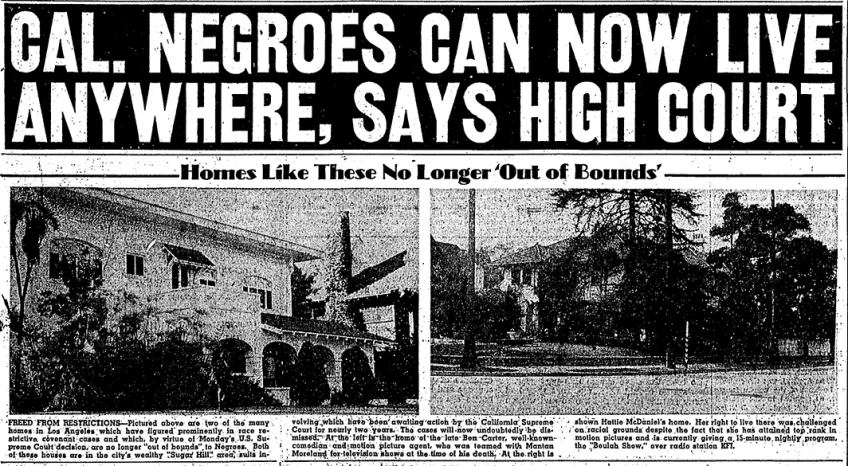
Successful Black homebuyers
Despite these challenges, lots of Black people still found a way to make it work. But just because they bought the house doesn’t mean that they could keep the house. The lack of available credit in Black neighborhoods, made getting loans for repairs next to impossible. The roof might have been leaking for a while (some of us have even seen permanent buckets to catch drips), the house could have had plumbing issues or furnace issues.
So many maintenance and repair issues were common in homes that couldn’t get loans for repair, that even if the kids still lived in the house they grew up in, they didn’t really want to be there. It might have been a free place to live, but the place still needed a lot of work. Even if your grandparents or great grandparents managed to buy a home, the likelihood of that home still being in good conditions is quite low—that’s if they even managed to hold onto it. And if you’re in a city as old as Philadelphia, then you know this story all too well. And this is the key point to understanding why real estate is a different wealth vehicle for Black people vs whites. What do those aunts and uncles that grew up in that home do when nobody has the money to fix it and no body really wants to be there?
Homeownership alone will not build generational wealth
The act of building wealth requires more than just acquiring the three forms of assets that we named at the beginning. There are more moving pieces that lots of our grandparents didn’t understand. One critical piece that’s missing for a lot of Black people is estate planning. This is more than just creating a will. Creating a will is great, but if you leave a house to your four children the title to the house will be tangled amongst those four heirs and who’s in charge and who gets to do what becomes a mess—even in the most loving and functional families.
Heirs properties
Even in and ideal situation where everyone gets along, not all of the heirs are going to want to live in their childhood home as adults. People want to start their own families and buy their own homes. This is going to be true even if the property is in GREAT shape (to say nothing of a house that not in great shape).
Uncle Dave sold grandmom’s house!
This is a story that most of us already know: Junior might still be living in the house, but Aunt Renee wants to rent the property out and Uncle Dave wants to sell to get his cut (maybe even for a down payment). The heirs can’t come to an agreement and there are so many heirs properties in Black families that are in limbo because of tangled titles that the estimated value is upwards of $35 billion. That’s $35 billion of locked up capital that Black families can’t use, can’t pass on to the next generation, can’t use to send anybody’s kids to college. It’s the very opposite of building generational wealth. Having a designated heir to the property and/or some basic estate planning is important to being able to pass wealth from one generation to the next, but it still takes more than that.
Building a foundation for wealth
So what’s it going to take to successfully begin amassing and passing wealth? The sobering reality is that you must start with mindset. Your real estate agent won’t ever begin with mindset (because they don’t get a commission for selling you mindset). Your lender will not begin with mindset for the exact same reason. This discussion around mindset is FREE! Yet, it’s absolutely critical that you understand the very foundations. Our grandparents and great-grandparents didn’t understand it. And, to be honest, our parents didn’t understand it either. If we are going to break the cycle of living in survival mode, MINDSET is first and foremost
There is no quick fix
Home ownership is a key component, but it won’t fix wealth gap. We’ve already addressed this with grandmom’s house, but it bears repeating because I meet people all the time that think that once they’re homeowners, all their problems will be solved and they’ll be living the good life. This is especially true by the time someone has fallen into the web of a real estate agent.
The truth of the matter is that there is no silver bullet! There is no one thing that you will do that will set you up for life. If that were true, then everyone would just do it and the world would be perfect. It doesn’t matter if it’s a multi-family unit, either. Contrary to everything that you see on social media, neither a duplex, nor a triplex, nor a four-family unit will bring you wealth. Your ability to work those assets and learn along the way can set you up for financial freedom. But you will have to work. I have been in lending and housing for a long time and I’ve originated mortgage loans for lots of triplex owners. Those owners who jump in and do all the stuff themselves (I mean, they be IN that property): they do well. Those owners who want to outsource everything (contractors, property managers): they do less well. More importantly, they never build the skill set that allows them to scale to even more properties. It’s true that landlording is not for everyone, but that’s usually not the biggest issue. The biggest issue tends to be one’s ability to add value to value chain—a core principle of the market place. If you don’t know contracting, and you don’t know construction, and you can’t add anything thing to the value chain, then you’re essentially hoping that your ability to get a loan is enough to get you wealthy.
On the other hand, if you’re willing to invest in yourself and build skills in a particular area, then you can make the investment work for you. And it doesn’t matter whether that investment is crypto, real estate, web development, social media marketing, the stock market, fx (be careful), or sales. Building sharp, focused skills is a critical component for having the right mindset.
Mindset is everything

I grew up in the housing projects of West Philly and I watched my mom shoot down so many opportunities to get out of the projects. I had so much shame about living there that whenever her cousin Cecilia would offer to help her buy a home for cheap, my ears would perk up. Once, Cece even offered to give her a house! It was in decent condition, too. My mother never took her up on the deal because living in public housing represented stability to her. In reality, public housing provided the prospect of delaying change for as long as possible.
My mother’s income wasn’t the roadblock to building wealth (we were below the poverty line for sure, but a free house?), it wasn’t the lack of information because Cece was a real estate queen when Philly still looked like a Blaxploitation movie. None of the most common reasons that people think of as obstacles applied. My mother’s biggest obstacle was her own belief system.
But this is true for us all. Ninety-nine percent of what it takes to build wealth happens it our minds, yet we live in our own mental cages of what we believe is possible and what we believe we can have. The biggest barrier that we face to amassing wealth is, like it or not, our own thinking. The good news is, breaking free is not that hard
Developing a wealth mindset
Once we understand that there are no quick fixes, no shortcuts, and that the biggest obstacle that we face is our own belief system the formula for building generation is wealth is quite clear. The following framework provides the central directives critical for building W.E.A.L.T.H. :
- Want wealth
- Escape wages
- Adjust your lifestyle
- Leave yourself slack
- Train the primary asset
- Hedge yourself
Want… Wealth
You must actually want wealth! Whether you’re aiming to get balance-sheet wealth in the positive or build to something truly spectacular, the first step to building wealth… is wanting wealth. A lot of people respond to this with something like, “I got that part down! Next!” I’m going to argue, however, that contrary to our initial reaction, wanting wealth is deceptively daunting and tends to actually be hardest part of the challenge.
In my financial coaching practice, I routinely ask people what it is that they want and they routinely answer with:
- what they don’t want
- what they think they can have
- what they think they should want.
There is a place for all of those things, but none of those things answer the question, “What do you want?” These responses are, in fact, much easier questions to consider. There a huge gap, however, between what we actually want and what we think we can have and therein lies the rub. The reason for this is purely psychological.
We Want the stuff
Allowing ourselves to actually want wealth sends the self a tacit message that we’re not where we want to be. This is not always easy to admit. Most of us will tell ourselves that “I’m fine!” even when we really aren’t. This realization immediately triggers the awareness that we’ll have to do something different. And we don’t actually want change, we just want the stuff: we just want the house, we just want the car, we just want the bag; the watch; the vacation, we just want the relationship. We don’t want to change who we currently are to get any of those things. And to be honest, we don’t need to. You can get the house, the car, the relationships, and take the vacations without changing one iota of who you are or how you move. But what you’ll find in the end, is that you won’t have anything that resembles wealth. #noshortcuts
The consumer mentality is different than the investor/builder mentality and as we pursue consumable goods—when we make the stuff our goal—we lose sight of the plan. This invariably leads us to max out our affordability on a home and end up with mortgage payments that are 30%-45% of our gross income; we end up with these outrageous car notes for assets that will never appreciate; we end up with the stuff but not the peace of mind.
What if it doesn’t work?
The other reason that wanting wealth is the primary challenge is because it opens us up for failure. This notion is devastating to our egos and our very identities and so we end up playing small so that we never face the possibility of losing. Instead of leaning in and saying what they truly want, you hear people say, “I just want to be comfortable”, or “I just want enough to be OK”. They’re signaling the fact that they’re playing small with the word just. What they’re actually saying is, “I’m afraid to play all-out.”
This is the other reason that the consumerism is so appealing. Once you get the Benz or the Bentley or whatever it is, you will get IMMEDIATE accolades from you broke friends. As soon as someone says, “OKAY! I see you!”, you’re going to feel amazing and you should! But buying stuff never confronts you with, “what if I fail?”
What if instead of maxing out your PITI (principle-interest-taxes-insurance: essentially your mortgage payment), you buy less than what you can afford? If you buy less than you can afford, it, by definition, means that you’re going to get less than what you can afford. Maybe the house is not in the neighborhood that you want, or smaller than you want, or doesn’t have a backyard or deck or patio or garage. Whatever it is, if you buy less than what you can afford, you make a sacrifice. If you buy the used Toyota instead of the Lexus you will get exactly zero OkayIseeyou’s and you won’t get that amazing feeling that goes along with that.
What if you make all of the sacrifices and it doesn’t fucking work? Then what? This question, this scenario, this fear is why allowing yourself to actually want wealth is the hard part.
Escape wages
Once we’ve conquered the psychological barriers to building a wealth mindset, it critical that we understand that for 99% of us, generational wealth won’t ever come from your 9-to-5. We have to figure out ways to uncouple what we earn from the number of hours that we spend working. Even at the highest income brackets, you still can’t achieve financial independence without uncoupling your income from your time. During the 2008 financial crisis, we saw CEOs that were making $600k/year ($900k in today’s money) that couldn’t afford their lifestyles once they were downsized. Doctors, also, know this all too well. Trading money for time means that we’re handcuffed to our present circumstances and doesn’t position us to be able to pass wealth to the next generation.
Breaking these handcuffs means that we’ll have to invest in assets, build a business, or both. Personally, I advocate for entrepreneurship, but entrepreneurship is tough and not every lane is for everybody. There is no ONE way to get to your destination and you’ll have to find what works for you.
Some people don’t have the stomach for the stock market (or don’t want to learn) while others hop right into the crypto markets; some want to build a real estate empire while the notion of being a landlord is detestable to others. Finding a wealth building vehicle (like property or long-term investments) or an building an income stream outside of your 9-to-5 is critical to your establishing foundational wealth no matter what lane you choose. The most sustainable approach, however, it to find a lane that excites you: one that engages your mind and makes you want to keep learning. It doesn’t take a lot to be come better than average. You just have to do a little bit more than average.
Profits are better than wages.
-Jim Rohn
Adjust your lifestyle
There’s a concept called a lifestyle inflation whereby the more we tend to make, the more we tend to spend. This is not unreasonable behaviour as we make our way out of poverty. For those who start with very little, it only makes sense that our spending increase as our income increases. But once we’ve stabilized and things have gotten a little nicer… the spending still continues to increase. Nearly all of us have experienced this, but the mechanics of how this works are insidious.
As you buy once we no longer need to rely on the most basic of basics, we’re absolutely going go buy ourselves a treat with that new money. And we absolutely deserve it. But as that new money continues to grow in our accounts, the likelihood of us treating ourselves again is kinda high. And we deserve it, right?
The problem comes in when the things that used to be treats, now seem like bare minimum or even necessities. Now, we remember when these things were treats, but your brain adapts and they don’t feel like treats anymore. Once this happens, how do you treat yourself from there? Well, we buy the even better version; the version that seemed out of reach or “not worth it” or “ain’t nobody paying that for that” is now like, “let me see for myself what X is about”. And wouldn’t you know… X ain’t that bad. Then, all of sudden we see what they was talkin’ bout. Do this enough times, however, and X, too, will become bare minimum.
The net effect of this, and the reason why I think it’s insidious, is that we end up with significantly more income, but not significantly more wealth. I once had client who was making $20k/mo. at Google for at least four years, still lived at home with mom in the hood paying no rent. Her car was paid off, she took plenty of trips with “the girls” to nice places, but only had $13k in savings. Her 401k was just ok; no investments. Her credit cards were maxed out and she assured me that she paid them off every month, but she only had $13k in savings! And she thought she was doing just fine. Her lifestyle had inflated with that new money so quickly that she scoffed at the idea of scaling back.
After I read her the riot act, I had to reflect on my own behaviour. She represents, for sure, the most extreme version of lifestyle inflation that I’ve ever seen, but I could see a version of her behaviour in myself. Most of us are guilty of it because it happens so slowly that we’re barely aware of it, but it’s something that we absolutely need to tackle.
Striking the balance between your new money, your new spending, and your ultimate financial goals must be at the forefront of our awareness at all times. Everyone has different values and are price insensitive to different things, but the easiest way to thing about this is to just spend below your means.
If you keep the idea of spending below your means as a true north, you’ll naturally strike the balance because everything in you will tell you what you won’t compromise on. Those “must haves” will bubble right on up as soon as you try to cut back. For everything else, though, we want to spend as little as your brain will allow: because it’s not how much money you make, but how much money you keep.
Leave yourself slack
To understand the concept of slack, we first have to dive into the scarcity mindset. While the notion of a scarcity mindset is usually contrasted with an “abundance mindset”, behavioural economists Sendhil Mullainathan and Eldar Shafir define the scarcity mindset in a very different way in their book, Scarcity.
Scarcity
Through a series of experiments and they find that the human brain makes worse decisions:
- when we are hungry – calorie scarcity
- when we don’t have enough money to cover our needs – financial scarcity
- when we don’t have enough time in our schedule – time scarcity
- (this is particularly important for people who work a ton of overtime)
- when we’re highly distracted – cognitive scarcity
- when we’re lonely – social scarcity
The crazy part is the brain responds in similar ways to all these forms of scarcity. In all cases we:
- become overly focused on the immediately lack (the “fire” in front of you)
- ignore the things that might have long-term consequences
- make more mistakes
- fail to build in any kind of buffer—slack—which makes it harder to recover from mistakes or even just random encounters with chaos.
Slack
If scarcity is the problem, then slack is the solution. Slack is just additional buffer: it’s extra time, money, or even social support that’s built into the way that we operate. When we have enough slack in our lives, we can plan differently, delay things, say ‘no’ to things that we don’t want to do, say ‘yes’ more often to the things that we want, and choose more easily among options (as opposed to just picking the first thing)
By building in slack, we can pivot more easily. Imagine negotiating with your wage job (or your clients) knowing that you don’t need this job (or these clients). That’s a whole different vibe! The biggest bonus to slack, though, and how it relates to wealth building is just the ability to think through investment decisions differently. You can think about what strategies are actually right for you and your long-term goals instead of just jumping on what you saw on Instagram. For that matter, with enough slack in your life, you could even read a book or two about a potential strategy. If you don’t have slack, you ain’t boutta read no books, pa’tna.
Train the primary asset
At least one grade school teach would have told you that the greatest asset that you possess is the one between your ears. It’s cheesy, but it’s not wrong. Easily the best tool in your arsenal is your ability to develop your own mind. Investing in yourself with pay dividends in your life that you could not imagine. There is literally no greater investment that we can make than investing in ourselves. Trial and error and the hard knocks of life are going to teach us no matter what, but intentionally investing in ourselves will change our lives so much faster because it just shortens your learning curve and allows us to make fewer mistakes. The easiest way to accomplish this is with books.
Reading
The importance of reading almost goes without saying, but there are enough people who stop reading books once they finish their formal schooling (at any level). In fact, I was one of them. I thought that I was smart enough and, “ain’t no body got time to read!” This is the easiest way to stay broke. I thought that I knew enough but I wasn’t getting the results that I wanted. Period.
Reading is necessarily to cornerstone of building wealth. Leaders are always readers and that’s not by mistake. Reading allows you to consistently fill in the gaps in your knowledge much more quickly than just trial and error (which will happen automatically anyway). By intentionally filling in the gaps, we continuously update our model of the world and the underlying principles behind how the world actually works start to emerge. Once we understand these principles and have built a robust model, we can much better predictions and we’ll be much less likely to be caught off guard which allows us to manoeuvre or pivot more easily.
For example, I have friend who thought that getting a PhD would be the leg up that he needed to move into a new financial bracket. I told him that a PhD is going to open some doors, but it wasn’t going to do what he thought it would. There are many good reasons to do a PhD, but unless you’re studying in an FTE field (Finance, Technology, Engineering), the pursuit of more money is not one of them. We both know a lot of people in common who have a PhD and maybe 1% of those people have actually built foundational wealth. He was ignoring the other 99% because he thought that ONE THING was going to be his salvation. It wasn’t #noshortcuts It wasn’t until about two years after he finished his program that he admitted, “This PhD money ain’t hittin’ like I thought”.
Although I told him from the outset, he hadn’t updated his model of the world sufficiently to know how things work. To be fair, he was a reader, but he read things that were incongruent to his goals which is why he didn’t have a good, predictive model of the world. If the goal is a leaner physique, reading about wealth won’t help you. If the goal is a better relationship, reading about fitness won’t do the trick. Books are relatively cheap, so it’s easy to fall into a book rabbit hole where you just want all the books, but the goal of your reading has to be in alignment with overall goals (you can skip the book on Genghis Khan until you’ve built real expertise).
Courses, trainings, and seminars
Courses, trainings, and seminars generally represent a significantly larger investment than books, but allow you to interact with a teacher, guide, or coach that can give you immediate feedback and immediate clarity. As you continue on your wealth journey and consistently, courses and trainings will be invaluable to sharpening your expertise and being able to leverage what you’ve learned. There’s a hidden benefit that comes from this level of personal development, though: the mastermind.
Once you’re in a cohort of people who are trying to develop their lives in the same area as you, something magic happens. You exchange stories about what you learned and in what order. The insights from your cohort accelerate the build-out of your model of the world as they connect dots that you haven’t and you connect dots that they haven’t. It’s lowkey amazing. As you continue on your wealth journey, you’ll likely lose some old friends, especially the ones that don’t want to see you win (lose them ASAP!) However, once you start to build relationships with people who are moving in the same direction, it’s an awesome force
Coaching and Mentorship
If you don’t already have a mentor, enlisting the services of a coach, financial advisor, financial planner, broker, etc. is going to the biggest investment in training your asset. As stated earlier, you’re gonna learn and grow either way, but if you can learn directly from someone else’s expertise in real time, it’ll just make your life better, faster. A coach/mentor/etc. offers immediate and continuous feedback. Once you’re in a feedback loop you can correct your errors and misunderstandings more quickly, introduce more advanced tools at a faster rate, and update your model of the world faster and more accurately.
This approach is helpful for beginners, especially those who don’t have as much time to invest. Coaching becomes absolutely necessary, however, for those who have mastered the basics, already started seeing some success and still want to level up.
How foundational wealth becomes generational wealth
Investing in yourself and training your greatest asset is the bedrock to transitioning from foundational wealth to generational wealth. Assets alone won’t set your kids up and it certainly won’t do much for your grandchildren. We’ve already seen this with heirs properties, but we can just look at new-money families that lost everything in a generation or two. Vanderbilt is probably the most famous example of this; Howard Hughes, too. But even closer to home we see people destroyed wealth in their lifetime like MC Hammer or quarterback Vince Young. There will be no shortcuts for you and, likewise, there will be no shortcuts for your children or grandchildren. They will still have to work, but hopefully they can have the privilege of doing work that they love. Therefore, the greatest advantage that you can pass on to successive generations is an understanding of the principles. Principles are everything: they’re the difference between wealth that dissipates in one lifetime and wealth that lasts hundreds or even thousands of years. Principles allow you to rebuild if chaos even breaches the walls; and entropy is undefeated. The most elite strategists, however, don’t rely on principles alone. They also hedge themselves against the chaos.
Hedge yourself
Even the best models lose sometimes. No matter how good your strategy is, there the unanticipated move from your competitors or the world could be your undoing in one fell swoop. Having a “Plan B” which affords you another income stream or allows you to pivot isn’t just a good idea, it’s how you stay in game. The popular notion that you don’t need a Plan B if you believe enough, can’t point to a single instance of anything great that works that way. If you’re going to live to fight another day, you must hedge yourself. Just ask Nokia
Lessons from Nokia

Under the leadership Olli-Pekka Kallasvuo, aka OPK, the world watched as Nokia fumbled the ball. Nokia was the world-leader in what we would call “dumb phones” today and they had the market cornered for smartphones. Nokia was a giant when most Americans didn’t know what a smartphone was and those who did really only knew the Canadian Blackberry.
In 2006 Nokia had the most sought-after and most technologically advanced smartphone in the world: the N95. It was truly a marvel for it’s time. The N95 was so far ahead of what other producers could do, Nokia seemed untouchable. But there were rumours by the end of 2006 that Apple was producing a phone. “Apple the computer company?” The smartphone producers of the world ridiculed the very idea. “Apple should stick to computers” was the consensus by the major players at the time (Nokia, Sony Ericsson, Samsung, Blackberry). By early 2007, Steve Jobs had revealed the keyboardless iPhone.
While Apple fanatics were literally crying with joy, the rest of the tech world ignored the iPhone and predicted its demise. Within a few short years, however, it was clear to the entire world that Apple had been underestimated and now mobile tech had to react. Nokia’s response were a series of disasters as they simply could not respond to the iPhone quickly enough. Before OPK could blink, the world of mobile telephony had shifted and every subsequent attempt to save Nokia telephony failed. Nokia was done… as a handset producer. But Nokia yet lives!
Nokia now
There are so many lessons to be learned in the history of Nokia. There’s the tragic lesson about complacency and not taking upstarts seriously which led to the veritable death of the handset division. But there’s also another side. While Nokia may have fallen from the world’s largest handset producer, it also hedged.
Nokia invested heavily in antenna technology, cellular network technology, and mobile infrastructure. Much of the world’s mobile tech couldn’t function without Nokia’s patents and network technology. With annual revenue of about $20B, Nokia continues decades after its “demise” because it hedged correctly.
This is not just the story of Nokia, though, it’s also the story of Apple, Microsoft, Amazon… the list goes on. The most valuable companies in the world hedge and so does Snoop.
Lessons from Snoop
“What is Snoop Dogg up to professionally these days?”, Diana Kander asks in one of her famous keynote speeches. It’s a good question. In provider her audience with a glimpse of what Snoop is up to, she contrasts his current position, unfortunately, with that of Vanilla Ice who at one point actually outsold Snoop; hard to believe, but not that hard if you really think about it. Vanilla Ice is apparently doing 90s reunion tours and has scrambled to start flipping houses. Snoop on the other hand has sold his stake in the Metaverse for $1.2 million, has sold $44m worth of NFTs along with his last record, has an ice cream brand with his son, has a YouTube channel dedicated to children’s songs and nursery rhymes, and Snoop Loopz breakfast cereal. He’s famous for his collaborations with Martha Steward and has a $100m venture capital fund. With the house flipping, it’s clear that Vanilla Ice has pivoted, but he has scrambled to do so. Snoop hedged himself and that has not only made him one of the most successful rapper-into-moguls of all time, it has also allowed him to stay in the game that he loves most.
How to hedge yourself
Pursuing multiple income streams the wrong way will make you hate your life. I’ve seen people who are trying to build Turo fleets, while doing AirBnB, and trying to flip properties. They end up with no natural nexus between any of the business, no vertical market, no horizontal market, and lots of stress. They’re serving different customers with different processes and different strategies. Nightmare! They eventually burn out and lose some if not all of the businesses because that approach is simply not sustainable.
To hedge yourself sustainably:
You can serve the same set of customers with different products or solutions
Think about a business geared toward restaurants. Most times, they will such as much as they can must to keep that customer dollar. WebstaurantStore, for example, serves restaurants as its primary customer. It sells meat, refrigerated display cases, coffee, ketchup, stools, tables, mops… literally anything and everything that a restaurant needs to operate.Hedging yourself in this way usually requires lots of infrastructure, or expertise, or both. If you love a particular niche, however, hedging vertically could be worthwhile
You can serve different customers with the same, translatable process
Think about how UPS and Paychex are pretty much business agnostic. They have a process and a solution that a myriad of customers can fit into. Who or what that customer is doesn’t much matter; the process is the same.Hedging yourself in this way is great option if you have a process solution. The infrastructure costs tend to be lower, too. Distribution is the key
Generational Wealth
Once you get your mind right, the resulting clarity will make life a joy. This entire process will feel no more challenging than driving a car. Driving a car might actually be this best metaphor, here. Different destinations will require different traveling times and how fast or carefully you drive will be up to you; but you’ll have clear visibility.
Following the W.E.A.L.T.H. formula outlined above is a clear roadmap to not only developing a model and establishing the habits for building wealth in your lifetime, but also the key to transferring true generational wealth. While it’s true that there’s no silver bullet
and no shortcuts, having a proper roadmap means wasting less time through trial and error.
It would be amazing if it were simple and you could set it and forget it, but were that the case everyone would have that wealth. The reasons that we simply have less is a combination of policies directed against us and the ignorance of not knowing how things work.
The policies are… better… but the key aspect that we can leverage is our information and our labour. Read the books, do the works, and the ability to turn things around for your entire family will be at hand.